

Low volume manufacturing services make sense when you need anywhere from a handful to a few thousand parts without the tooling investment and lead time that mass production demands. They beat mass production when speed to market, design flexibility, or demand uncertainty matter more than the lowest possible per-unit cost, typically during product launches, design validation, bridge production, or for niche and replacement parts. The tradeoff: per-part cost is higher, but you avoid committing capital to hard tooling before demand is proven.

When Do Low Volume Manufacturing Services Beat Mass Production?
Low volume manufacturing services win whenever demand is unproven, designs might still change, or the cost of committing to hard tooling outweighs a higher per-part price.
What Is Considered Low Volume in Manufacturing?
Low volume production is not defined by a hard unit cutoff. It is defined by the absence of permanent tooling. A run might be a single bracket machined for a field test or several thousand enclosures built before a mold is cut, both count, because neither depends on hard tooling to justify the cost .
Fathom frames it as the range between early prototyping and long production runs, dozens to several thousand units, prioritizing flexibility over the cost-per-unit efficiency that mass production chases . Protolabs positions it similarly, as the bridge connecting rapid prototyping to full mass production, built on automated processes that skip the setup time traditional tooling requires .
Key Advantages of Low-Volume Production for Getting to Market Faster
Mass production assumes you already know the design is final and the demand is real. Hard tooling, injection molds, stamping dies, casting tools, can take weeks to build and locks the part geometry in place once it’s cut. If sales fall short or a design flaw surfaces after launch, that tooling cost is stranded.
Low-volume methods remove that bet. CNC machining and 3D printing go straight from CAD file to finished part with no mold or die standing between them, which is why RCO Engineering and others position high-mix, low-volume work as the connective tissue between prototyping and full-scale manufacturing . That structure fits a specific set of business conditions well:
- New product launches, ship to early customers before volume is proven.
- Design validation batches, test form, fit, and function on real production-grade parts, not just prototypes.
- Bridge production, keep shipping while hard tooling for the high-volume run is still being built.
- Spare and replacement parts, produce exactly what’s needed without warehousing excess inventory.
- Seasonal or niche demand, match output to a market too small or too irregular to justify dedicated tooling.
The tradeoff is direct: you pay more per unit, but you buy speed, the freedom to revise a design between runs, and zero risk of tooling that never earns back its cost. 4U Machining applies that logic across CNC machining, 3D printing, and sheet metal fabrication, quoting within 4-24 hours so fewer decisions need to be locked in before parts start shipping. That compressed decision window is often the real advantage, not the unit cost, but how many fewer irreversible commitments stand between a design file and a finished part.
What Manufacturing Technologies Work Best for Low-Volume Production?
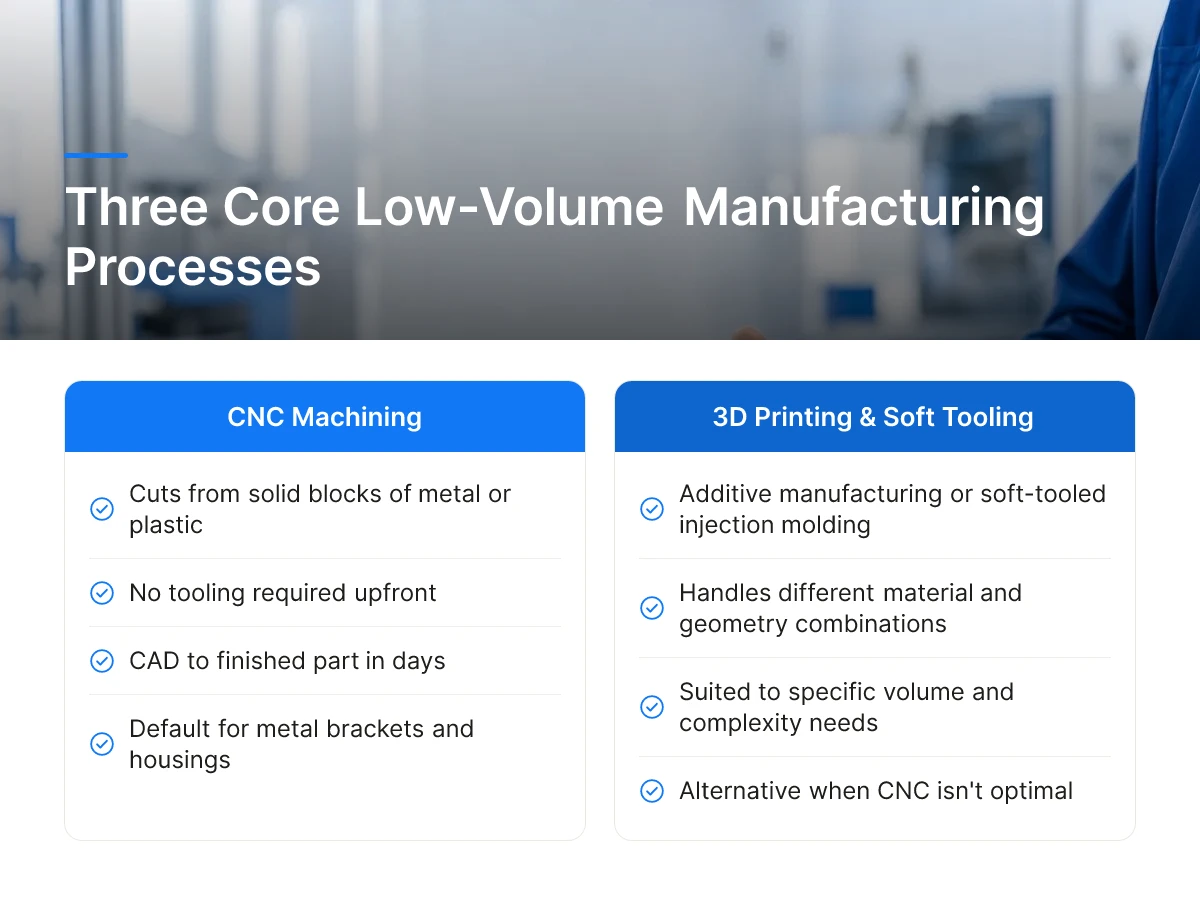
Three processes cover most low volume manufacturing services: CNC machining, additive manufacturing (3D printing), and soft-tooled injection molding, each suited to a different combination of material, geometry, and quantity.
Main Processes: CNC Machining, Injection Molding, and 3D Printing
CNC machining cuts parts from solid blocks of metal or plastic using programmed tool paths. There’s no tooling to build first, the machine just needs a program and a block of material, so a shop can go from CAD file to finished part in days. This makes CNC the default choice for metal brackets, housings, and functional prototypes that need to hold tight tolerances.
3D printing builds parts layer by layer directly from a digital file, skipping tooling entirely. That’s what makes it the fastest route for complex geometries, internal channels, or one-off and single-digit quantities where even a short CNC setup isn’t worth it. The trade-off is weaker material properties and rougher surface finish compared to machined or molded parts.
Injection molding needs a mold, usually aluminum or a low-cavity steel tool for short runs, before any parts get made. That tooling step adds lead time upfront, but once the mold exists, per-part cost drops fast, which is why molding pays off once volume climbs into the hundreds or thousands of plastic units.
How Precision, Speed, and Cost Compare Across Technologies
CNC machining delivers the tightest tolerances and best repeatability part after part, which is why it’s the default for metal components or assemblies with mating surfaces. 3D printing trades some dimensional accuracy and surface finish for geometric freedom, it handles shapes CNC tooling physically can’t reach. Soft-tool injection molding sits between the two: surface finish and repeatability approach production-grade quality, but only for plastic parts and only once the mold is built.
Matching process to part comes down to three questions: What’s the material? How complex is the geometry? And how many units do you need this quarter versus next year? A metal part with a tight tolerance callout points to CNC. A plastic housing with undercuts and organic curves, needed in single units, points to 3D printing. A plastic part headed for hundreds or thousands of units points to soft-tooled molding, since that’s where the tooling investment starts paying for itself. 4U Machining runs all three processes, CNC machining, 3D printing, and injection molding, under one roof, so parts can shift from prototype to short-run production without switching vendors or re-validating quality standards.
How Do Costs, Timelines, and Quality Compare Across Methods?
Costs, timelines, and quality control all shift depending on whether a process uses tooling, and the right comparison depends on volume, part complexity, and how many design changes you still expect.
What Drives Cost and ROI When Choosing Low-Volume Manufacturing
Tooling-free processes, CNC machining and 3D printing, carry a higher per-part cost because every unit is cut or printed from scratch, with no mold or die to spread costs across. The upside is that there’s no amortization risk: if the design changes or the order never scales up, you haven’t sunk money into a tool that’s now scrap.
Soft-tooled and hard-tooled processes, like injection molding, die casting, and cold forging, work in reverse. You pay for mold or die fabrication upfront, which only pays off once volume clears a certain threshold. Below that threshold, the per-part savings don’t outweigh the tooling bill. Fathom frames this as the core trade-off of low-volume work: flexibility and speed versus the cost-per-unit efficiency that long runs of simple geometries deliver.
Weigh this as a return-on-investment question, not a simple price comparison. Faster market entry and lower exposure to obsolete tooling, which matters if a design is still likely to change, are worth paying a premium for in the early stages of a product’s life. Protolabs describes low-volume production as the bridge between prototyping and mass production for exactly this reason, it lets a company validate demand before committing to hard tooling.
How Turnaround Time and Quality Control Differ by Method
Turnaround time differences trace back to one variable: whether a tool needs to be designed and built before the first part exists. CNC machining and 3D printing go straight from CAD file to machine program, so a design revision can appear in the next batch within days. Injection molding and die casting require new mold or die work for any significant geometry change, which adds lead time back into the schedule.
Quality assurance matters as much as speed when evaluating low volume manufacturing services, since small batches leave little room to absorb a bad part. First-article inspection, in-process checks, and documented process controls apply at low quantities the same way they apply at high ones, a single-digit production run still gets measured against the drawing before it ships. Protolabs lists ISO 9001:2015, ISO 13485, AS9100D, and ITAR among the certifications relevant to production-grade low-volume work, and 4U Machining verifies parts through ISO 9001-certified processes with an on-time delivery guarantee on every order, regardless of batch size.
Not covered here: process-specific tolerance capabilities and material-by-material cost comparisons, which depend on the part itself.
What Materials and Design Constraints Matter for Low-Volume Runs?
Material choice and tolerance for complexity shift once tooling costs disappear from the equation, which is exactly why low volume manufacturing services open up design options a production mold would never allow.
Material Limitations and Constraints Specific to Low-Volume Production
CNC machining and additive manufacturing handle a broad range of metals and plastics directly from raw stock or powder, with no mold to constrain the choice. Aluminum, stainless steel, titanium, and engineering plastics like PEEK or nylon are all realistic options for a short run without any upfront tooling investment.
Soft-tooled injection molding behaves differently. Because the mold itself, typically aluminum rather than hardened steel, wears with every shot, resin selection matters more. Abrasive or high-temperature resins accelerate tool wear, which narrows the practical material list compared to what a hardened production mold could run.
Design-for-manufacturing rules also loosen at low volume. Undercuts, thin walls, textured surfaces, or tight internal features that would force an expensive multi-cavity hardened tool become viable, because there’s no per-cavity cost to amortize across tens of thousands of parts. A geometry that would get rejected or heavily revised for mass production can often go straight to the machine or printer instead.
That flexibility has a ceiling. Soft tooling degrades faster than hardened steel molds, so dimensions drift after a limited number of shots, the realistic run length is capped well below what a production tool delivers before quality becomes inconsistent. Teams planning a bridge run need to know that number before committing a production order to a soft tool.
Parts intended to scale later deserve a second look at this stage. Keeping draft angles, wall thicknesses, and tolerances within ranges a hardened mold could eventually reproduce means the low-volume design migrates to mass production without a full redesign. 4U Machining’s quoting process surfaces these constraints early, CNC machining, 3D printing, injection molding, and sheet metal fabrication quotes within 4-24 hours, so design trade-offs get made before parts are cut, not after a batch comes back out of tolerance.
When Should You Transition from Low-Volume to Mass Production?
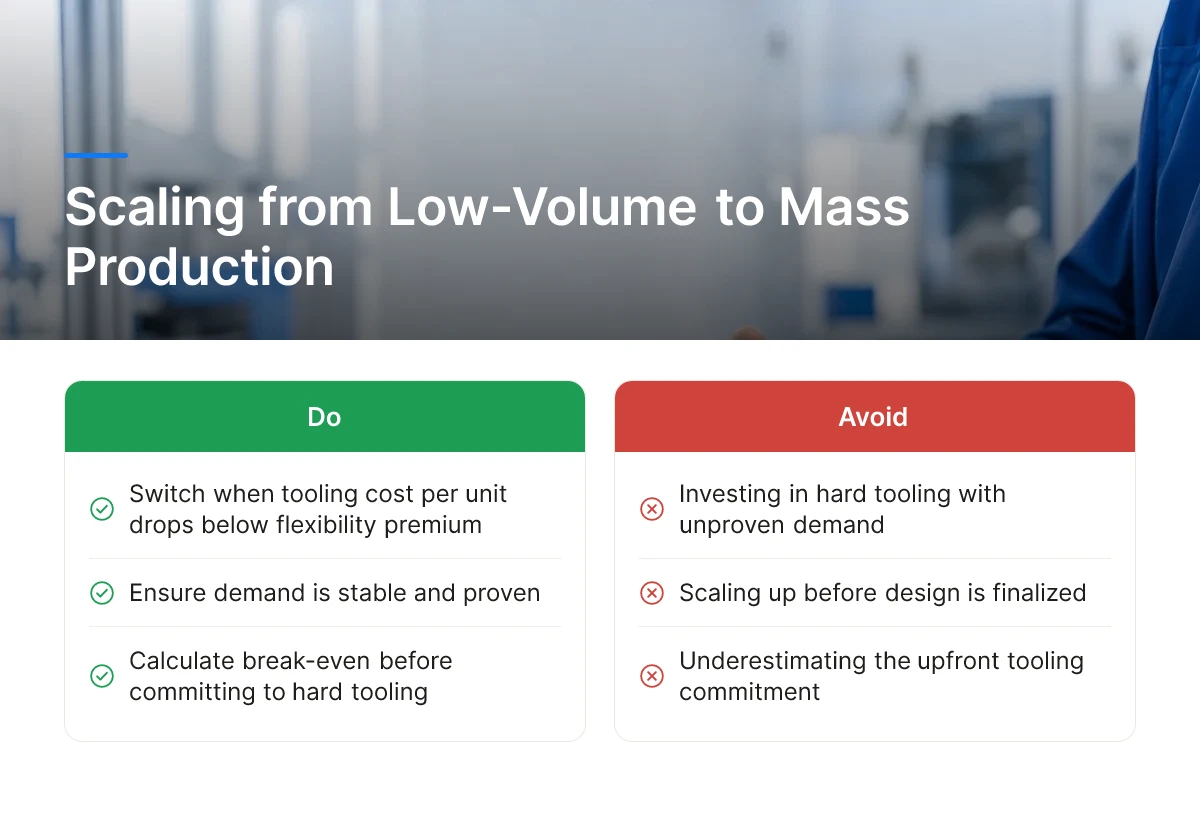
Switch to hard-tooled mass production once amortized tooling cost per unit drops below the per-unit premium you currently pay for flexibility, and demand is stable enough to justify the commitment.
That tradeoff sits at the center of every scale-up decision. Low volume manufacturing services charge more per part because they skip hard tooling, you’re paying for flexibility, not giving away margin. Mass production flips that: a large upfront tooling investment gets spread across tens of thousands of units, driving per-unit cost down, but only if you actually sell that volume.
How to Calculate the Break-Even Point for Mass Production
The math is straightforward even without exact figures: divide total tooling cost by the per-unit savings mass production offers over your current process, and that gives you the unit volume at which tooling pays for itself. Below that volume, you lose money on unused tooling capacity. Above it, every additional unit is cheaper than what you’d pay through on-demand production. Protolabs frames low-volume production as a deliberate bridge between prototyping and full-scale manufacturing precisely because this crossover point rarely arrives on day one.
Run this calculation against your actual sales forecast, not your hoped-for one. A design selling steadily can justify tooling faster than one with uncertain or seasonal demand, even at a similar unit price.
Signals That Tell You It’s Time
- Design stability: no engineering changes in recent production cycles, and no pending revisions on the roadmap.
- Demand consistency: forecasted orders are steady rather than seasonal or speculative.
- Cost pressure outweighs flexibility: per-unit price has become the dominant business concern, more important than the ability to make quick design tweaks.
When those three line up, tooling starts paying for itself instead of sitting idle.
Bridge Manufacturing Keeps Supply Moving
Hard tooling takes weeks to fabricate, and most companies can’t afford a supply gap while it’s built. A staged approach, running low-volume production as bridge manufacturing during tooling fabrication, keeps parts shipping without interruption. Fathom and RCO Engineering both describe this exact role for low-volume work: covering demand while higher-volume tooling comes online.
The bigger risk runs the other direction. Locking in tooling before a design is finalized is expensive, a single engineering change can force a full retool, and that rework often costs more than the per-unit savings ever delivered.
Frequently Asked Questions
Can you switch manufacturing processes midway through a product’s life without redesigning it?
Often yes, but it depends on how the part was originally designed. Parts designed with manufacturability in mind from the start can move between 3D printing, CNC machining, and injection molding with minimal rework. This is one reason working with a single manufacturing partner across the full product lifecycle pays off, the design history and tolerances carry over instead of getting lost between vendors.
Is low-volume manufacturing only useful for prototypes?
No, low-volume manufacturing covers everything from early prototypes to production runs of several thousand units. It also serves bridge production, replacement parts, and limited-run products that never need mass-production volumes, like specialized industrial or medical equipment.
How does part complexity affect the choice between CNC machining and 3D printing at low volumes?
Simple geometries with tight tolerances usually favor CNC machining, while intricate internal features or organic shapes favor 3D printing. CNC machining cuts from solid stock, so deep cavities or undercuts add cost and time. 3D printing builds layer by layer, so complexity is nearly free, but surface finish and material strength are tradeoffs to weigh against machining.
Does low-volume manufacturing support metal parts, or just plastics?
Low-volume manufacturing supports both metals and plastics across multiple processes. CNC machining and die casting handle aluminum, steel, and other metals at low volumes, while 3D printing and injection molding cover plastics and some metal powders, giving you material options without committing to mass-production tooling.

Conclusion
Choosing low-volume manufacturing comes down to three decisions: pick the process that matches your part’s geometry and material, confirm your partner can scale with you from prototype to production, and verify quality systems like ISO 9001 are in place before you commit. Lead time and vendor consistency matter more than per-unit cost when you’re iterating on a design.
If you’re still deciding, upload your CAD file to 4U Machining for an instant quote and compare the turnaround and process recommendation against what your current supplier offers.
Recommended Articles
Explore more from our content library: