

Understanding aluminum precision machining is essential. 6061, 7075, 6063, 2024, and 5083 are the aluminum alloys most commonly chosen for precision CNC machining, each balancing machinability, tolerance capability, and cost differently. 6061 suits general precision parts needing good machinability and corrosion resistance at a moderate cost. 7075 and 2024 deliver higher strength for aerospace and structural components but cost more and machine slightly slower. 6063 is ideal for cosmetic, thin-walled parts, while 5083 excels in marine and high-corrosion environments. The right choice depends on matching the alloy’s hardness and thermal behavior to your tolerance requirements and budget.

1. 6061 Aluminum
6061 is the default alloy for aluminum precision machining because it balances machinability, moderate strength, and corrosion resistance better than any other grade in common use.
It cuts cleanly at high speeds, holds tight tolerances without excessive tool wear, and resists atmospheric corrosion without a protective coating in most environments. These traits make it the first choice for general-purpose precision parts: enclosures, brackets, fixtures, and mounting hardware where strength requirements are moderate but dimensional consistency matters. This is particularly relevant for aluminum precision machining.
What often gets left out of alloy comparisons is how well 6061 welds and anodizes after machining. It accepts Type II and Type III anodizing with consistent color and finish across batches, which matters for assemblies that combine machined and welded sub-components, a detail that keeps surface appearance uniform across a production run. 7075, by contrast, anodizes less predictably and doesn’t weld as cleanly.
On cost, 6061 sits in the budget-friendly to mid-range tier relative to higher-strength alloys like 7075 or fatigue-rated grades like 2024. Combined with fast cycle times, that makes it the material most shops quote first unless a design spec rules it out.

2. 7075 Aluminum for Aluminum Precision Machining
7075 delivers aerospace-grade strength in aluminum precision machining but costs more to machine because its hardness accelerates tool wear and demands slower feeds.
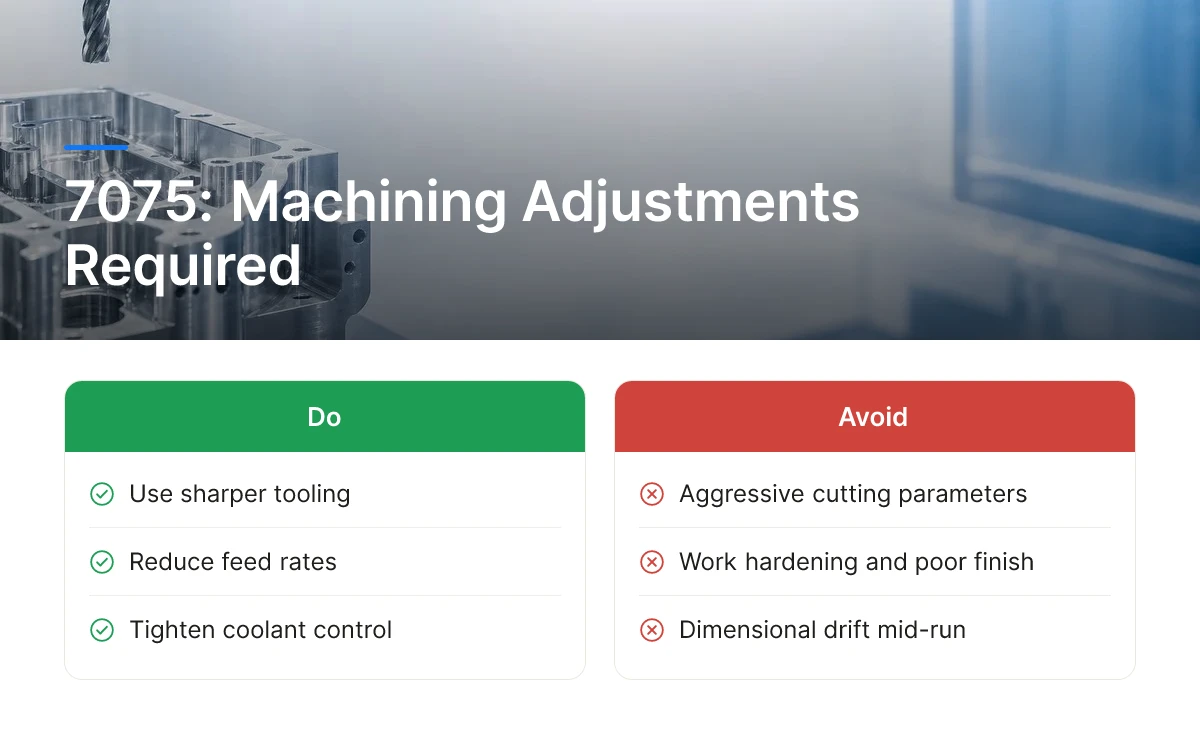
Where 6061 forgives aggressive cutting parameters, 7075 punishes them. Its higher hardness generates more heat at the cutting edge, so shops running 7075 need sharper tooling, reduced feed rates, and tighter coolant control to avoid premature tool failure and maintain tolerance. Skip these adjustments and you get work hardening, poor surface finish, or dimensional drift mid-run.
The payoff is strength-to-weight performance that 6061 can’t match. 7075 shows up in aerospace brackets, high-stress fittings, and load-bearing precision components where every gram matters but failure isn’t an option.
How Do 6061, 7075, and 5083 Aluminum Alloys Compare in Machining Performance and Cost?
6061 machines fastest and cheapest, 5083 trades some machinability for corrosion resistance and weldability, and 7075 sits at the top for strength but the bottom for machining ease and corrosion resistance. 7075 is notably more vulnerable to galvanic and stress corrosion than 6061, which is why parts exposed to moisture or salt air typically need a chromate conversion or anodized coating before service.
Expect 7075 to carry a premium cost tier, raw material runs higher than 6061, and slower machining parameters add cycle time. For parts where failure risk or weight savings justify it, that premium is the entire reason to specify the alloy in the first place.
3. 6063 Aluminum
6063 is the go-to alloy when a precision part also needs to look good, thanks to a surface finish quality that outperforms 6061 and 7075 after anodizing. When considering aluminum precision machining, this point stands out.
It’s the alloy architects and product designers reach for when a visible, consumer-facing part has to look as good as it machines. Enclosures, trim pieces, and architectural hardware all benefit from 6063’s clean, consistent surface after anodizing or polishing.
Its real differentiator is extrudability. 6063 was developed for extrusion, which means it holds tight dimensional control on thin-wall sections without warping, a property that matters when a design calls for slim profiles or intricate cross-sections machined from extruded stock.
It also machines faster than 6061 in many operations, trimming cycle time on high-volume cosmetic runs. The trade-off is structural strength: 6063 isn’t the choice for load-bearing brackets or fasteners, but for anything where appearance and dimensional precision outrank raw strength, it’s hard to beat.
4. 2024 Aluminum
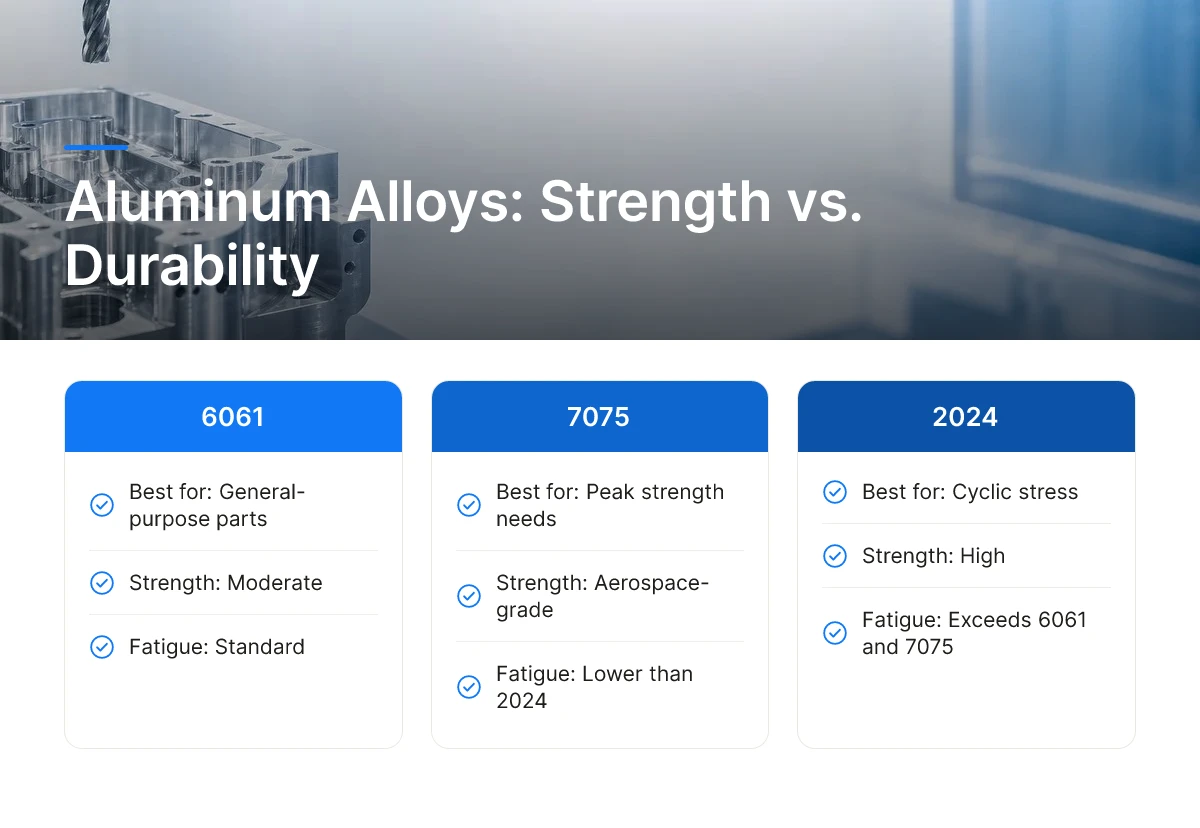
2024 aluminum is specified when a precision part must survive repeated stress cycles, since its fatigue resistance exceeds that of 6061 and 7075 alike.
Its strength-to-weight ratio makes it a staple in aerospace structural components, wing skins, fuselage sections, and fittings that flex thousands of times over a service life without cracking. Where 7075 wins on peak strength, 2024 wins on durability under cyclic load.
Machining it requires more attention than 6061. 2024 is prone to built-up edge formation on the cutting tool, which degrades surface finish and accelerates wear if left unmanaged. Cutting fluid selection matters more here: the right coolant reduces adhesion at the tool-chip interface and keeps edge quality consistent, something that’s far more forgiving with 6061.
Like 7075, 2024 trades corrosion resistance for strength. Most 2024 parts ship with a protective coating or cladding, since bare 2024 is more susceptible to corrosion than 6061 or 5083 in humid or marine environments. For those exploring aluminum precision machining, this matters.
5. 5083 Aluminum
5083 is the alloy of choice for marine and chemical-exposure parts because its corrosion resistance in salt water and harsh environments surpasses every alloy on this list.
It holds up in conditions that would pit or degrade 6061 or 7075 over time, which is why it shows up in marine hardware, pressure vessels, and outdoor structural components exposed to weather or chemical contact.
What Are the Machinability Ratings and Precision Capabilities of Different Aluminum Grades?
5083 machines with more tool wear than 6061 but holds tolerances reliably in aluminum precision machining applications where corrosion performance outweighs cycle-time savings. Its biggest differentiator: excellent weldability without the strength loss that heat-treatable alloys like 7075 or 2024 suffer after welding, since 5083 is non-heat-treatable to begin with.
That non-heat-treatable status defines both its ceiling and its machining behavior. Hardness comes entirely from strain hardening and alloy content rather than heat treatment, which caps achievable hardness compared to 6061-T6 or 7075-T6 and produces a slightly different tool wear pattern, more abrasive, less prone to work hardening at the cutting edge.
For a shop quoting across all five alloys, 5083 sits at mid-range to premium cost depending on form, justified by corrosion performance rather than raw machining speed.
Why Aluminum Suits Precision CNC Machining Compared to Other Metals
Aluminum cuts faster and holds dimensions better than steel or titanium because it is softer, conducts heat away from the cutting edge quickly, and still delivers enough strength for most structural parts.
Can Aluminum Be Machined to the Same Precision Tolerances as Harder Metals?
Yes, for most applications. Aluminum shops regularly hold tolerances in the ±0.002″ to ±0.005″ range on CNC milling and turning equipment. Aluminum can fall short of steel or titanium on extremely thin-wall or high-aspect-ratio features, where the metal’s lower stiffness lets it flex or spring back under cutting force, in those edge cases, fixturing design matters more than the alloy spec sheet.
Why Is Aluminum Easier and Faster to Machine Than Steel or Titanium?
Lower hardness means less resistance at the cutting edge, so tools wear slower and keep their geometry longer, a direct driver of tolerance consistency across a production run. Aluminum’s thermal conductivity pulls heat away from the cut zone before it can distort the part, a known failure mode in titanium, which retains heat and warps during long cycles. Faster cutting speeds and shorter cycle times follow naturally, which lowers per-part machining cost compared to steel or titanium jobs requiring slower feeds and more tool changes. This directly impacts aluminum precision machining outcomes.
On strength-to-weight, aluminum alloys like 7075-T6 approach the tensile strength of some mild steels at roughly one-third the weight, which is why aerospace and automotive engineers specify aluminum precision machining wherever weight reduction matters as much as structural integrity.
Preventing Defects and Maintaining Tolerances in Aluminum Machining
Most aluminum machining defects trace back to two causes: tool deflection from inadequate workholding, and heat buildup that shifts dimensions mid-cut.
What Causes Tool Marks and Chatter in Aluminum Machining, and How Do You Eliminate Them?
Chatter happens when the cutting tool deflects and bounces against the workpiece instead of cutting cleanly, usually because the fixture isn’t rigid enough or the spindle speed and feed rate don’t match the tool’s natural frequency. The fix is mechanical before it’s a programming fix: tighten workholding, shorten tool overhang, and reduce stepover before adjusting speeds. Once rigidity is confirmed, dialing in spindle speed and feed per tooth removes the vibration that leaves visible tool marks on the finished surface.
How Do You Maintain Dimensional Stability Throughout the Machining Process?
Heat buildup from sustained cutting expands the aluminum workpiece slightly, and if that expansion isn’t managed, parts measure out of tolerance once they cool. A deliberate coolant strategy, flood cooling or mist, depending on the operation, combined with a cutting sequence that avoids concentrating heat in one area keeps dimensional drift within spec. Roughing passes followed by a finishing pass after the part stabilizes thermally is standard practice for tight-tolerance work.
Verification happens after the cut, not instead of good process control. Coordinate measuring machine (CMM) inspection checks critical dimensions against the drawing, while surface finish gauges confirm the part meets roughness callouts. Quality frameworks like ISO 9001 and AS9100 structure how that inspection data gets recorded and traced back to the production batch, giving manufacturers and customers a documented chain of custody rather than a one-off spot check.
Matching Lead Times and Volume to Your Aluminum Machining Project
Production volume changes which alloy and process decisions make sense, prototypes favor forgiving materials, high-volume runs favor cycle-time efficiency.
What Are Typical Lead Times for Small-Batch Versus High-Volume Aluminum CNC Orders?
Small-batch and prototype runs typically use 6061, an alloy known for forgiving machinability that lets engineers iterate on design without fighting the material. These runs prioritize turnaround over cutting-edge cycle time optimization, since the part count doesn’t justify extensive program tuning.
High-volume orders flip that priority. Once a design moves to production, the economics shift toward minimizing cycle time per part and managing tool life across thousands of cuts, since even small per-part savings compound at scale. Alloy selection may shift too, a grade optimized for machinability at high speed, like 2011, can outperform 6061 once volume removes the need for mid-run design changes. This is particularly relevant for aluminum precision machining.
Scalability planning means choosing an alloy and process at the prototype stage that will still make sense at production volume, rather than redesigning the part later. Cost tiers follow volume in a predictable direction: low-volume aluminum precision machining runs sit at a higher per-part cost tier, while high-volume runs push per-part cost down as setup and programming time amortize across more units. 4U Machining quotes projects within 4-24 hours at any volume, from single prototypes through high-volume production, so teams can plan alloy and process decisions around one partner rather than switching vendors as volume scales.
How to Choose the Right Aluminum Alloy for Your Precision Machining Project
Choose an aluminum alloy by locking in tolerance requirements first, then matching strength and corrosion needs, then weighing machinability against cost tier.
What Factors Should You Consider When Choosing Aluminum CNC Machining for Your Precision Parts?
Start with the tolerance the part needs, tight tolerances on thin-wall or high-aspect-ratio features narrow the alloy field before strength even enters the conversation. From there, match strength and corrosion resistance to the operating environment: heat-treatable grades like 6061 and 7075 handle structural load and outdoor exposure, while non-heat-treatable grades like 2011 trade some strength for higher-speed machinability. Cost tier gets weighed last, once the technical requirements have already filtered out unsuitable alloys.
Industry application changes how these factors get weighted. Aerospace parts favor the strength-to-weight ratio of 7075-T6 and tolerate a higher cost tier to get it. Medical components prioritize corrosion resistance and biocompatibility over raw machining speed. Automotive parts often land on 6061 as the balance point between cost, strength, and machinability for mid-volume production.
Design choices interact with alloy selection in ways that aren’t obvious until the part is on the machine. Thin walls and complex internal features increase the risk of deflection and chatter regardless of alloy, which means a design built around 2011’s speed advantage can still run slow if the geometry is unforgiving. Bringing a machining partner into the conversation during design, not after drawings are final, lets engineers validate alloy and tolerance feasibility before committing to production, which is where aluminum precision machining projects most often save time and avoid redesign cycles.

Frequently Asked Questions
What quality standards and inspection methods ensure aluminum parts meet precision requirements?
ISO 9001-certified process controls combined with coordinate measuring machine (CMM) inspection are the backbone of verified precision on aluminum parts. Shops also use go/no-go gauges, optical comparators, and surface roughness testers to confirm dimensions against drawing tolerances before shipment. 4U Machining verifies every production run against ISO 9001-certified quality processes and backs delivery with an on-time guarantee, so inspection isn’t an afterthought bolted onto the schedule.
How do aerospace, medical, and automotive industries use precision-machined aluminum differently?
Aerospace favors high-strength grades like 7075-T6 for structural brackets where weight savings matter most, while medical applications lean on corrosion-resistant 6061 for housings and surgical fixtures. Automotive typically runs higher volumes on 6061 or 2024 for brackets, manifolds, and housings where cycle time and cost per part drive the alloy choice. Aerospace and semiconductor work also increasingly pushes toward advanced alloys and 5-axis methods for lighter, more complex geometries.
What cutting tools and speeds work best for different aluminum alloys?
Carbide tools with polished flutes and high spindle speeds suit free-machining grades like 2011, while heat-treatable alloys like 6061 and 7075 need adjusted feeds to manage built-up edge. Aluminum’s low cutting resistance and clean chip formation allow higher speeds and lower tool wear than steel or stainless, which shortens cycle times across CNC milling, turning, and Swiss platforms.
How does aluminum machining cost compare to other materials?
Aluminum typically costs less per part to machine than steel or stainless because it cuts faster and wears tools less. Non-heat-treatable grades like 2011 run fastest on screw machines and Swiss lathes, while heat-treatable grades like 7075 cost more to machine but deliver strength approaching mild steel at one-third the weight.

Conclusion
Alloy choice drives everything else: 2011 for fast, low-cost runs, 6061 for balanced strength and corrosion resistance, 7075 when you need steel-like strength at a fraction of the weight. Match the alloy to the application first, then confirm the tolerance band your shop can actually hold, typically ±0.002″ to ±0.005″ for precision work. Don’t let quality verification be an afterthought; ISO 9001-certified inspection catches dimensional drift before it reaches your assembly line. Upload your CAD file and alloy spec to get a quote within 4-24 hours, and compare tolerance and lead-time commitments before you commit a production run.
Recommended Articles
Explore more from our content library: